
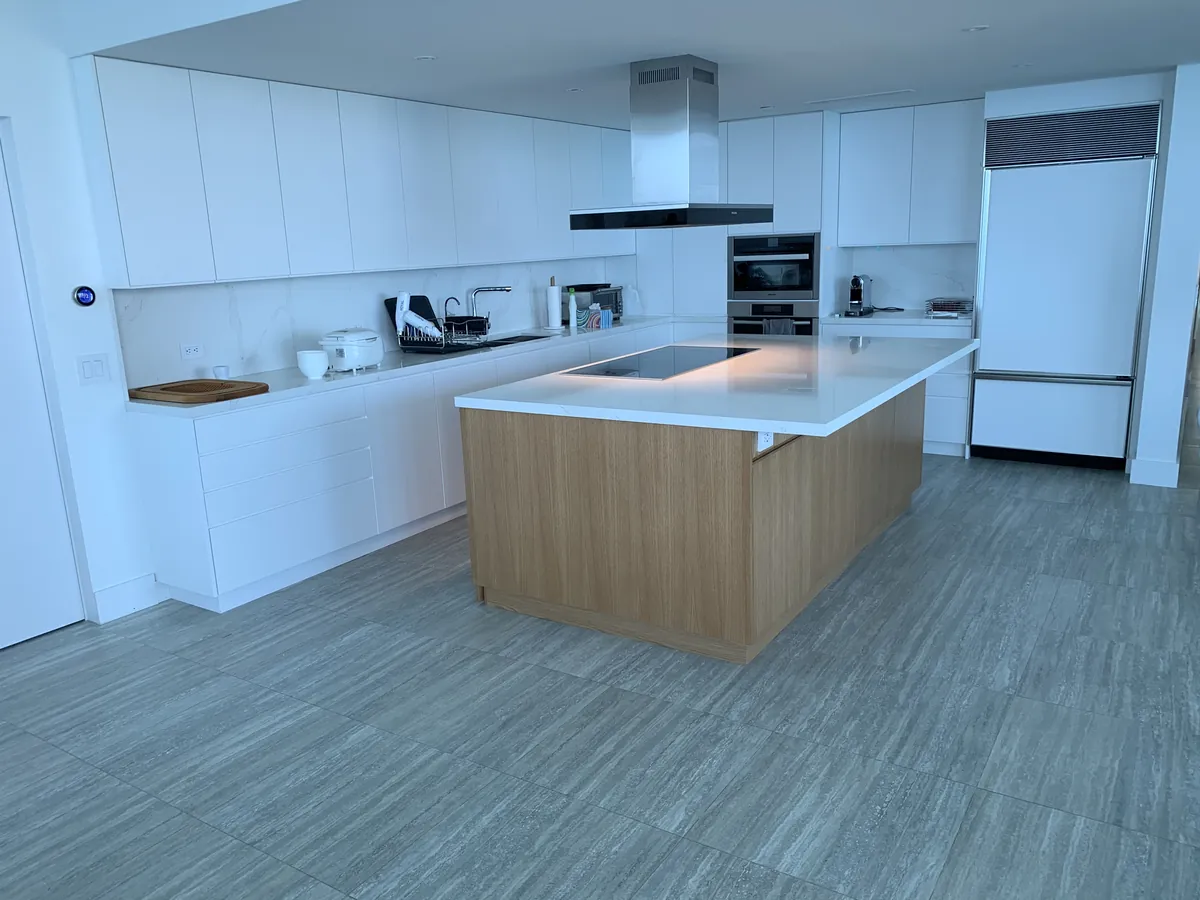
The photo above is a kitchen we built in our Fort Lauderdale shop, not a flood-recovery job. This post is about what to do when water has already reached your cabinets, and how we replace them when they can't be saved.
Storm surge, a tropical downpour, a burst pipe or a washed-out ground floor all leave the same problem at cabinet height: base boxes sitting in water. We are a custom cabinet shop, not a restoration company. We don't dry the house, and we don't reface damaged boxes. We build new kitchen cabinets, closets and bathroom vanities for homes in Broward, Miami-Dade and all of Palm Beach County, and we write an itemized quote you can share with your adjuster.
First steps after water reaches the cabinets
Safety comes first. Standing water and wet electrical are a bad mix. Don't go back in until the power is safe and the people handling the water damage say the rooms are safe to enter. We don't do that work, and we won't pretend otherwise.
Once you can get in, take photographs for your adjuster before anything is torn out. Shoot every room that got wet, the outsides and insides of the base cabinets, the toe kicks, the closet bases and the vanities, plus close-ups of swelling, staining or soft spots. We don't advise on what your policy covers. Your insurer and adjuster decide that. Clear photos just make it easier for them to see what happened.
Then get the rooms drying. Don't let wet particleboard sit. Once that material swells, it doesn't go back, and a closed, damp cabinet only holds the moisture longer. A restoration crew handles the drying. Our job starts after you can see which cabinets are still sound and which are not.
Why particleboard swells, and why plywood holds up better
Most stock and ready-to-assemble cabinets use particleboard boxes with a melamine face. Particleboard is wood chips and sawdust pressed with resin. When water gets in at an exposed edge, a screw hole or the bottom of a base cabinet, the chips soak it up and the panel swells. That swelling is permanent. The face may still look fine for a while, but the box is already failing: shelves get soft, screw holes strip, and doors stop lining up.
Plywood is a different construction. Thin layers of wood veneer are glued with the grain of each layer running across the one next to it, so the panel stays flatter and is much more forgiving of a short wetting. A small amount of water in a plywood box is often a nuisance. The same water in a particleboard box is often the end of the cabinet. We go through the materials side by side in plywood vs particleboard vs MDF.
Our custom cabinet boxes are built from Columbia Forest PureBond plywood, cut and assembled in our Fort Lauderdale mill. That is not a waterproof box, and no cabinet is flood-proof. Plywood holds up better than particleboard when it gets wet. It is not a promise that a cabinet will survive a flood. If you want the background on the panel itself, we wrote a separate post about Columbia Forest plywood. For how we use thickness in the box, see 1/2" vs 3/4" plywood for cabinets.
What can be saved, and what usually needs replacing
It depends on the material, how high the water sat and how long the cabinets stayed wet. We look at this with you in the room. We don't promise a cabinet can be saved, and we don't tell you to keep one that isn't sound.
- Upper cabinets that stayed dry are often reusable, including the doors, as long as the boxes are still square and the hardware still holds.
- Particleboard base cabinets that have swollen, gone soft or crumbled at the bottom or the edges usually need to be replaced. Paint or a new door won't fix the box.
- Plywood base cabinets are a closer call. If they were dried quickly and the sides, bottom and joints are still sound and square, they may be reusable. If the bottom has delaminated, the box has gone out of square or the screw holes no longer hold, the cabinet should be replaced.
- Doors and drawer fronts depend on what they're made of and how long they stayed wet. Some can be reused on new boxes; some can't.
We only build new cabinets. We don't reface a damaged box, and refinishing doesn't repair a swollen one. If you're weighing a cosmetic refinish against a full replacement for a kitchen that wasn't flooded, see refinish or replace kitchen cabinets.
Closets and vanities take the same floor-level water
Water doesn't stop at the kitchen. Closet towers, wardrobe bases and bathroom vanity boxes sit on the same wet floor, and particleboard in those rooms fails the same way. Built-in closet floors and toe kicks can wick water up into the sides. Vanity bases live next to plumbing, so they often take both floodwater and a later leak.
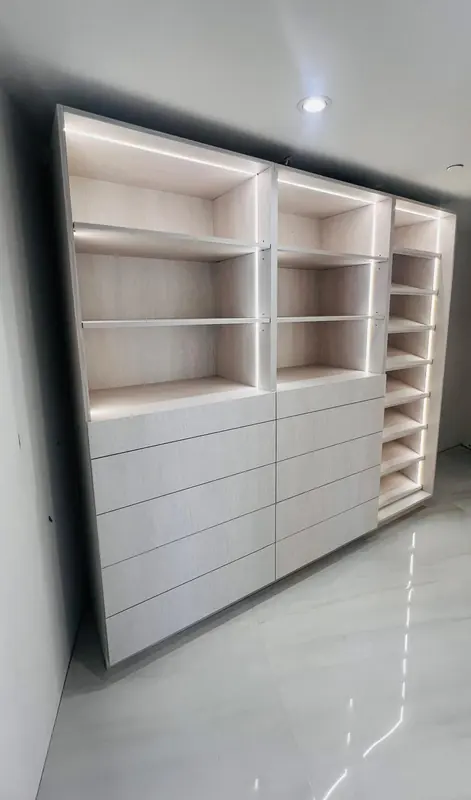
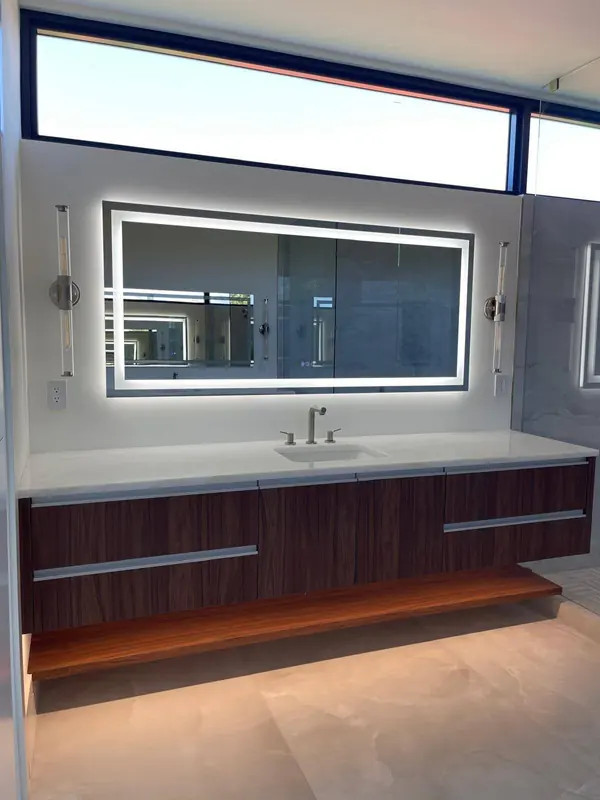
If those rooms were in the water, plan their replacement with the kitchen, not as an afterthought. See our custom closets and bathroom vanities for the work we build.
Raised toe kicks and legs
When we build replacement cabinets, we can set the box off the finished floor with a taller toe kick or with legs. The idea is simple: a future puddle has farther to go before it reaches the box. Floating vanities already sit off the floor for the same reason.
That is a practical detail, not flood-proofing. If water rises high enough, it will reach the cabinet. No cabinet we build, and no cabinet anyone else builds, is flood-proof.
An itemized quote you can share with your adjuster
For flood work, we write an itemized quote. Like-for-like replacement — putting back what was there — is listed on its own lines, apart from any upgrades you choose, so you can share the quote with your adjuster. Upgrades are your decision and are listed separately. We don't advise on what your policy pays for. The adjuster decides that.
The quote comes after we measure the rooms and you have drawings to review. Bring photos of the damaged rooms to the showroom if you have them, or call and we'll talk through what to send.
How replacement works, and how long it takes
A replacement project with us follows the same path as our other custom work:
- Measure visit. We measure the rooms and look at what can be saved and what should be replaced. What happens at a measure visit.
- Drawings. You review and approve detailed drawings before anything is cut.
- Build. Custom cabinets are built in our mill from Columbia Forest PureBond plywood, with Blum hardware. Lead time is 8–12 weeks from approved drawings.
- Install. Our own crew installs the new cabinets.
Designed, fabricated and built in the USA in our Fort Lauderdale shop. Visit our Fort Lauderdale showroom at 2416 S Andrews Ave, Fort Lauderdale, FL 33316 to see the work in person, or start with our custom kitchen cabinets. We serve Broward, Miami-Dade and all of Palm Beach County; see our service areas for the towns. Call 954-939-8579.