
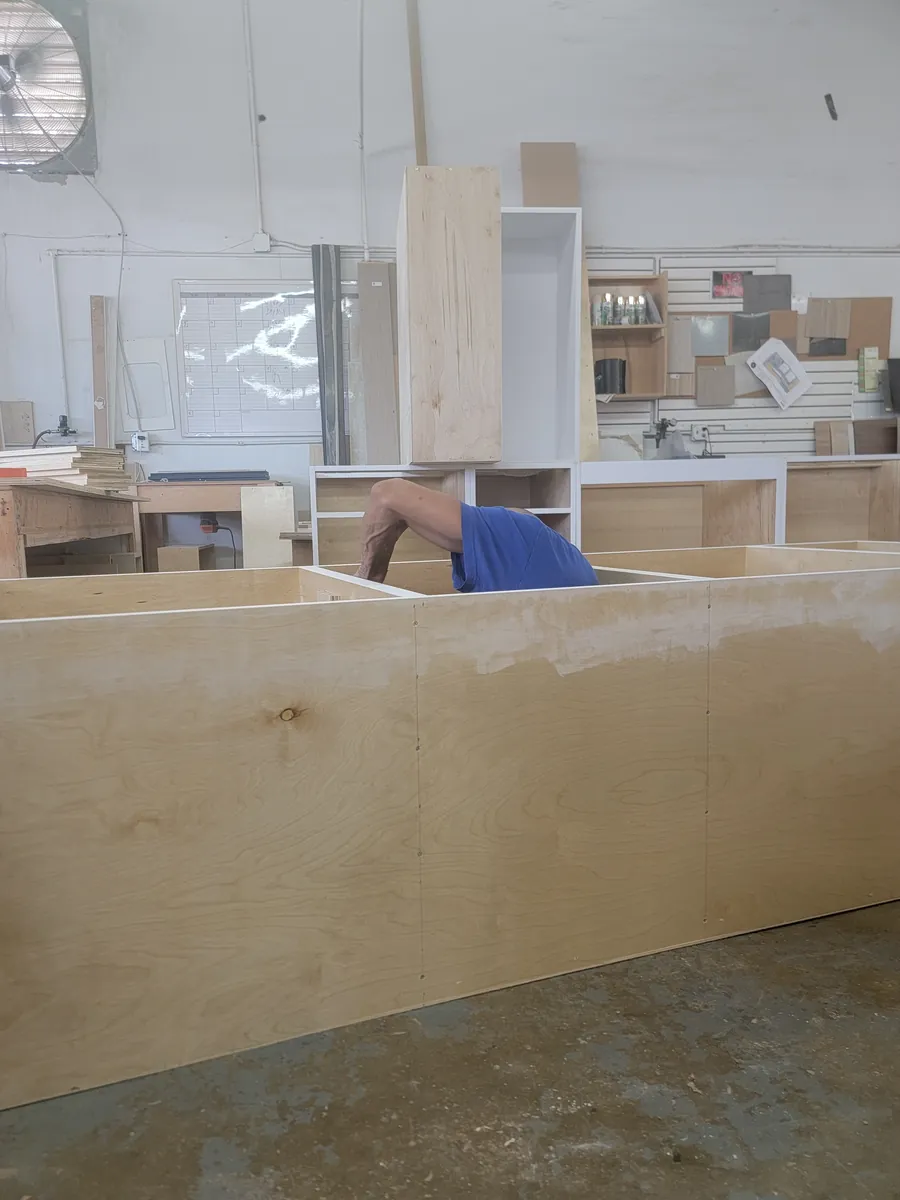
There isn't one right thickness of plywood for a whole cabinet. Each part does a different job. The sides carry the hinges and drawer slides. The shelves carry dishes. The back keeps the box square. The drawer bottoms just need to hold what's in the drawer. Good cabinetmakers match the thickness to the job, not one size to everything.
Here's how we think about where 1/2" and 3/4" plywood each make sense, and what to ask any cabinetmaker you're comparing. If you're still deciding between plywood, particleboard and MDF, start with our guide on plywood vs particleboard vs MDF for cabinets.
A quick note on sizes: "3/4" and "1/2" are nominal. Most plywood sold as 3/4" is a little thinner, and the same goes for 1/2". That matters when you cut joints, but it doesn't change anything below.
Cabinet boxes: sides, tops and bottoms
The box is the structure of the cabinet, and the sides do most of the work. In a frameless (European-style) cabinet, the hinge plates and drawer slides screw straight into the sides. Every time a door swings or a full drawer rolls out, those screws take the load.
That's the strongest case for thicker sides. A thicker panel gives each screw more wood to bite into and gives the joints more glue surface. It also leaves more room for error when holes are drilled close together.
Bottoms carry everything sitting in the cabinet, plus the weight of the cabinet above them in some layouts. A sink base also has to cope with plumbing cut-outs and the risk of the odd leak. Tops of base cabinets are often open or just rails under the countertop. The tops of wall cabinets help hold the box square.
For a kitchen that gets daily use, the sides and bottoms are where we don't cut corners. At Delta, our cabinet box sides and bottoms are 3/4" Columbia Forest PureBond plywood.
Backs
The back's main job is to keep the box square and give a solid place to fasten the cabinet to the wall. It doesn't carry a shelf load the way a side does.
Many cabinetmakers use a thinner back set into a groove, then fasten through a rail or a strip to the wall. Others use a full-thickness back so they can screw anywhere through it. Both can work. What matters is how the cabinet is hung: a wall cabinet full of plates is hanging from whatever the installer screwed into.
Ask how the cabinet is fastened to the wall, not just how thick the back is. Our backs are 1/2" thick, and our wall cabinets are hung by screwing through the back.
Shelves and sag on long shelves
Shelves are where thickness shows up most clearly over time. A shelf that's too thin for its span and load will slowly bow in the middle. Plywood, like any wood panel, can also creep: it keeps sagging a little more under a load that never comes off.
Three things drive sag:
- Span. The longer the shelf between supports, the more it bends. This is the biggest factor.
- Load. Dishes, cookbooks and canned goods are much heavier than glasses or linens.
- Thickness and edge support. A thicker shelf is stiffer. A solid-wood edge strip on the front, or a support along the back, stiffens it further.
If you want to check a specific shelf, online tools such as the Sagulator let you enter the material, span and load and estimate the sag. We'd rather you run your own numbers than take a chart on faith.
The practical rules: keep long shelves short where you can by adding a center support, use thicker stock on wide spans that carry heavy loads, and use thinner shelves where the span is short and the load is light. Our shelves are 3/4" thick and edge-banded.
Drawer boxes and drawer bottoms
Shops differ most on drawer boxes. Some build the sides from 1/2" plywood: it's lighter, gives you more usable space inside and looks cleaner from the side. Others use 3/4" sides for a stiffer box and more wood around the slide screws. Good joinery holds a drawer box together, not just the panel thickness.
Drawer bottoms carry the contents of the drawer. A wide drawer full of pots needs a stiffer bottom than a narrow drawer full of utensils. How the bottom is supported matters too: a bottom captured in a groove on all four sides is much stronger than one stapled to the underside.
The drawer slides do the heavy lifting. We use Blum hardware, and a good slide matched to the drawer's size and load makes more difference than a small change in thickness. Our drawer box sides are 3/4" and our drawer bottoms are 1/2".
Screw holding
Plywood holds screws well in its face and less well in its edge, because the edge is a stack of thin layers. A screw driven into the edge of a thin panel has less material on either side of it and is closer to splitting.
That's why thickness matters most where screws go into edges or where hardware is screwed in under load: box joints, hinge plates and slide mounts. For a back or a drawer bottom that's glued into a groove, edge screw holding barely comes into it.
Weight
A 3/4" panel of the same plywood weighs noticeably more than a 1/2" one, simply because there's more wood in it. Across a whole kitchen, that adds up.
Weight matters in a few places. Wall cabinets have to be carried, lifted and hung, and everything they weigh is hanging from the fasteners. Drawers feel heavier to open when the box itself is heavy. Panels have to be carried into the home. Extra thickness where it isn't needed just adds weight with nothing in return.
When 1/2" is perfectly fine
Thinner doesn't mean worse. Used in the right place, 1/2" plywood is exactly the right call:
- Drawer bottoms, which carry the contents of the drawer but no hardware load
- Backs, where the job is keeping the box square and giving a place to fasten it
- Short shelves with light loads, such as glassware or spices
- Dividers and partitions inside a cabinet that don't carry hinges or slides
- Panels inside built-ins that aren't carrying hinges or slides
Where 1/2" is the wrong choice: sides that carry hinges and slides, bottoms under heavy loads, and long shelves that hold dishes or books.
How we build at Delta Woodworks
We build every custom cabinet new, in our own mill in Fort Lauderdale, from Columbia Forest PureBond plywood with Blum hardware, and our own crew installs it. We choose the thickness part by part: 3/4" for box sides and bottoms, shelves and drawer box sides, and 1/2" for backs and drawer bottoms.
See how a cabinet comes together inside our mill, or explore our custom kitchens.