
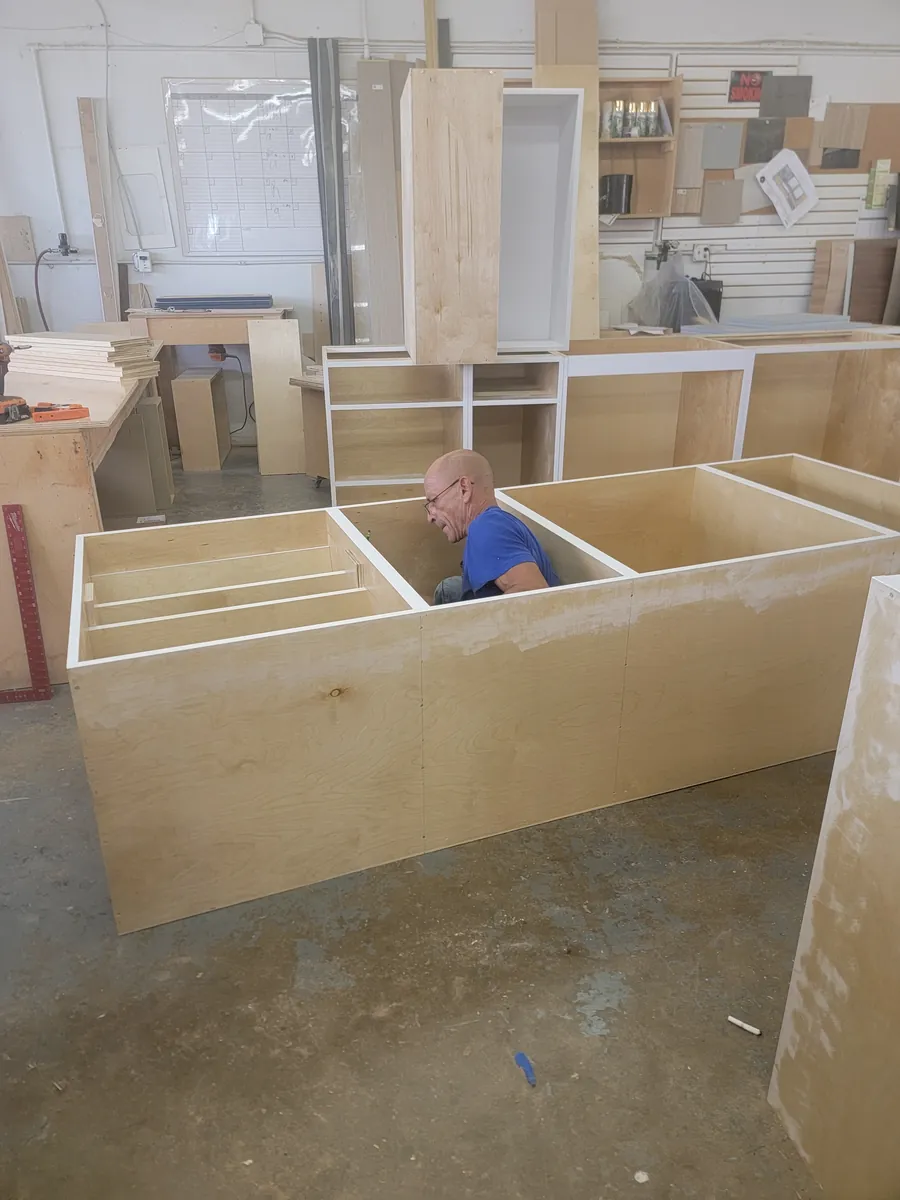
Two kitchens can look identical on the day they're installed and age completely differently. Most of that difference is hidden inside the cabinet: the sheet material the boxes, shelves and doors are made from. The three you'll hear about are plywood, particleboard and MDF.
What each material is
Plywood
Plywood is made from thin layers of real wood veneer, glued together with the grain of each layer running at right angles to the one next to it. That cross-grain construction is the point: wood moves mostly across its grain, and the alternating layers hold each other in check. The result is a panel that is strong for its weight, stays flat and holds screws well.
Cabinet-grade hardwood plywood has a smooth face veneer (maple, birch, oak, walnut and others) over the inner layers, so it can be left natural inside a cabinet or finished to match.
Particleboard
Particleboard is made from wood chips and sawdust pressed together with resin. On its own it's a rough brown board; in cabinets it's almost always covered with melamine or a laminate face. It's flat, inexpensive and consistent, which is why most ready-to-assemble and big-box cabinets use it.
Its weakness is water and fasteners. When particleboard gets wet at an exposed edge or a screw hole, it can swell, and once it swells it doesn't go back. Screws and hinge plates also pull out more easily than they do from plywood, especially after a hinge has been adjusted a few times.
MDF
MDF (medium-density fiberboard) is made from fine wood fibers and resin pressed into a very dense, very smooth panel. It has no grain and no voids, so it machines cleanly and takes paint beautifully. That makes it a common choice for painted doors and panels, and you'll find it in plenty of high-end work for exactly that reason.
MDF is heavy, and like particleboard it doesn't like water at an unsealed edge. It's a good door and panel material when it's well sealed and finished; it's a poor choice for a sink base box.
How they compare where it matters
- Strength and weight. Plywood is the strongest of the three for its weight. Particleboard and MDF are heavier and weaker in bending, so long shelves made from them sag sooner.
- Holding screws. Plywood holds screws, hinge plates and drawer-runner screws best, and it holds them again after adjustment. This matters with hardware you'll adjust over the years, like Blum hinges.
- Water. No sheet material likes standing water. But a small leak under a sink is a nuisance in a plywood box and often the end of a particleboard one.
- Flatness and paint. MDF wins for perfectly flat, paint-grade surfaces. Plywood shows its grain, which is beautiful stained but can telegraph through paint.
- Cost. Particleboard is the least expensive, which is the main reason it is used so widely.
Why it matters more in South Florida
Our climate is humid all year, and a lot of homes here sit near salt water. Air conditioning helps, but cabinets still live through power outages, hurricane-season closures, vacation homes that are shut up for months and the occasional slow drip under a sink. Under those conditions, a material that swells at the first sign of moisture is a weak link.
That's a big part of why we build our boxes from plywood. Read more about how humidity affects cabinets in our South Florida humidity guide.
What we use
Our cabinet boxes are built from Columbia Forest PureBond plywood, cut and assembled in our Fort Lauderdale mill, and every door and drawer runs on Blum hardware. If you'd like the background on the plywood itself, we wrote a separate post about Columbia Forest plywood.
Doors are a separate decision from boxes. The right door material depends on the style: a stained wood door, a painted door and a high-gloss handleless door are built differently. We'll show you the options side by side at the showroom and tell you what we'd recommend for your door style and finish.
Is particleboard ever fine?
Yes. Particleboard with a good melamine face is a reasonable material for some furniture, for budget projects and for dry spaces that won't see much weight or adjustment. Plenty of flat-pack lines are made from it, and for a rental or a short-term project it can be the right call.
Where we'd steer you away from it is anywhere with water (sink bases, vanities, laundry rooms), anywhere with heavy loads (pantries, long shelves) and anywhere you expect the cabinets to last through more than one countertop.
Questions to ask any cabinet maker
- What are the boxes made of: sides, bottoms, backs and shelves?
- What are the doors and drawer fronts made of, and how are the edges sealed?
- What are the drawer boxes made of?
- Whose hinges and drawer runners are used, and are they soft-close?
- Where are the cabinets built?
A good shop will answer all five without hesitating. Ask us at the showroom and we'll show you a cut sample of what we build with.
The short version
Plywood for boxes, especially in wet areas. MDF is a strong choice for painted doors and panels when it's well sealed. Particleboard is a budget material that does best in dry, light-duty spots. If you're planning custom kitchen cabinets, a bathroom vanity or a closet, come see the materials in person at our Fort Lauderdale showroom.