
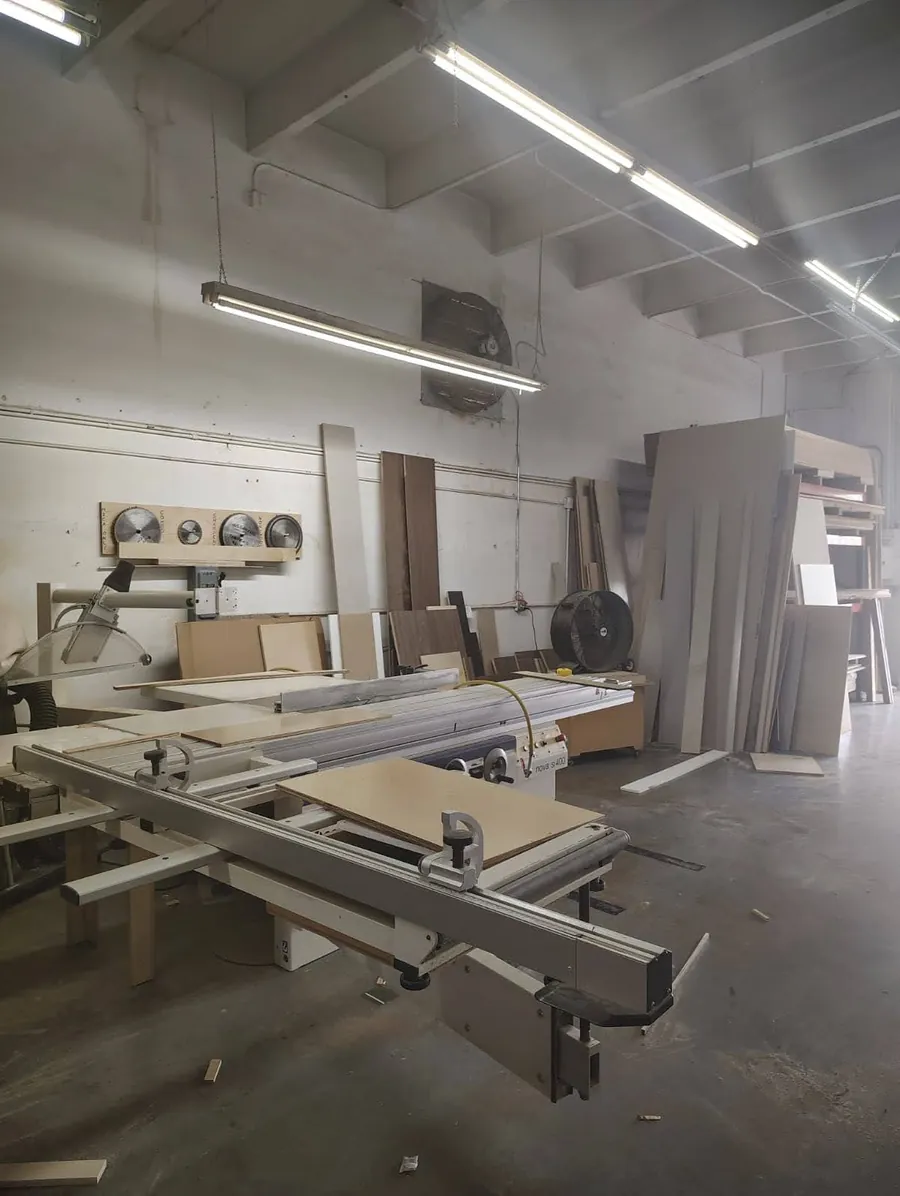
When people ask what our cabinets are made of, the answer is short: formaldehyde-free Columbia Forest PureBond plywood for the boxes; Blum hardware on every door and drawer; and everything built in our Fort Lauderdale mill. This post explains the plywood part.
What PureBond is
Columbia Forest Products is one of the best-known names in hardwood plywood, the panel that cabinet shops, furniture makers and architectural millwork shops build with. PureBond is its formaldehyde-free line.
A lot of conventional hardwood plywood is glued up with urea-formaldehyde adhesives. PureBond panels are made with a soy-based adhesive instead, with no added formaldehyde in the glue. That matters inside a home: cabinet boxes sit in kitchens, bedrooms and closets that stay closed and air-conditioned most of the year in South Florida, and you don't want the boxes themselves adding to what's in the air.
The soy-based adhesive doesn't give up strength to get there. PureBond panels are built for the same jobs as conventional hardwood plywood: flat, stable cabinet sides, bottoms and shelves that hold hinge screws and drawer runners for years. If indoor air quality matters to you, ask us which panel is specified for your job and we'll tell you exactly what's going in.
What "hardwood plywood" means
Construction plywood, the kind used for roof sheathing, is built to be strong and cheap, not pretty. It has rough faces and voids in the inner layers. Hardwood plywood is a different product. It has a smooth, sanded face veneer of a real hardwood (maple, birch, oak, walnut and others) and more carefully made inner layers.
For cabinets that matters in three ways:
- Flat, stable panels. Cabinet boxes need to be square for doors to line up. A flat, stable panel makes square boxes, and square boxes keep doors aligned for years.
- Clean edges and good screw holding. Hinge plates and drawer runners are screwed straight into the cabinet sides. Plywood holds those screws well and holds them again after adjustment.
- Finished interiors. The face veneer looks good inside a cabinet, so the inside of your pantry or glass-front cabinet looks like furniture, not like a box.
How it compares to what's in most cabinets
Most mass-produced cabinets, including many sold through big-box stores, are built from melamine-faced particleboard. It's flat and inexpensive, but it's weaker, heavier and much less forgiving of water. We covered the trade-offs in detail in plywood vs particleboard vs MDF.
In South Florida the difference shows up over time. Humidity, salt air, closed-up seasonal homes and the occasional leak under a sink are all harder on particleboard than on plywood. See our humidity guide for more.
From sheet to cabinet in our shop
Every sheet of plywood that becomes one of our cabinets is cut, machined and assembled in our own mill on S Andrews Ave in Fort Lauderdale. That's what we mean by designed, fabricated and built in the USA in our Fort Lauderdale shop. You can see the machines on our Our Mill page.
Roughly, a job goes like this:
- Measure and drawings. We measure the room ourselves and draw every cabinet to fit it.
- Cutting. Panels are cut to size from full sheets.
- Machining. Holes for shelf pins, hinge plates and drawer runners are bored where the drawings call for them.
- Edges. Exposed plywood edges are banded so the layers don't show and the edge is sealed.
- Assembly. Boxes are assembled square, then doors and drawers are fitted with Blum hardware.
- Install. Our own crew installs, scribes and adjusts everything on site.
Why we pair it with Blum
Good boxes and good hardware need each other. A great hinge in a weak box sags; a great box with cheap runners still feels cheap. Every job is built in our Fort Lauderdale mill with Blum hardware. We pair formaldehyde-free Columbia Forest PureBond boxes with Blum hardware on every job, and the cabinets are designed, fabricated and built here in our shop. Read more in our guide to Blum hinges and drawer runners and why we build everything in our own shop.
Where plywood shows
Inside a cabinet, plywood's face veneer is part of the look: open a pantry, a glass-front cabinet or a closet drawer and you see clean, smooth wood, not a printed surface. The banded edges look neat at the front of every shelf. And because the panel holds screws so well, shelves, pull-outs and accessories can be added or moved later without the holes crumbling.
What to ask any shop about plywood
- Are the boxes plywood throughout, or plywood sides with particleboard bottoms and backs?
- Who makes the plywood, and where?
- Are the shelves plywood, and how thick are they?
- Are the exposed edges banded?
- What adhesive is used in the panel, if indoor air quality is a priority for you?
See it in person
The easiest way to understand the difference is to hold a sample. Come to our showroom at 2416 S Andrews Ave, Fort Lauderdale, FL 33316 and we'll show you the plywood we build with next to a piece of particleboard, and walk you through kitchens, closets and built-ins built from it.