
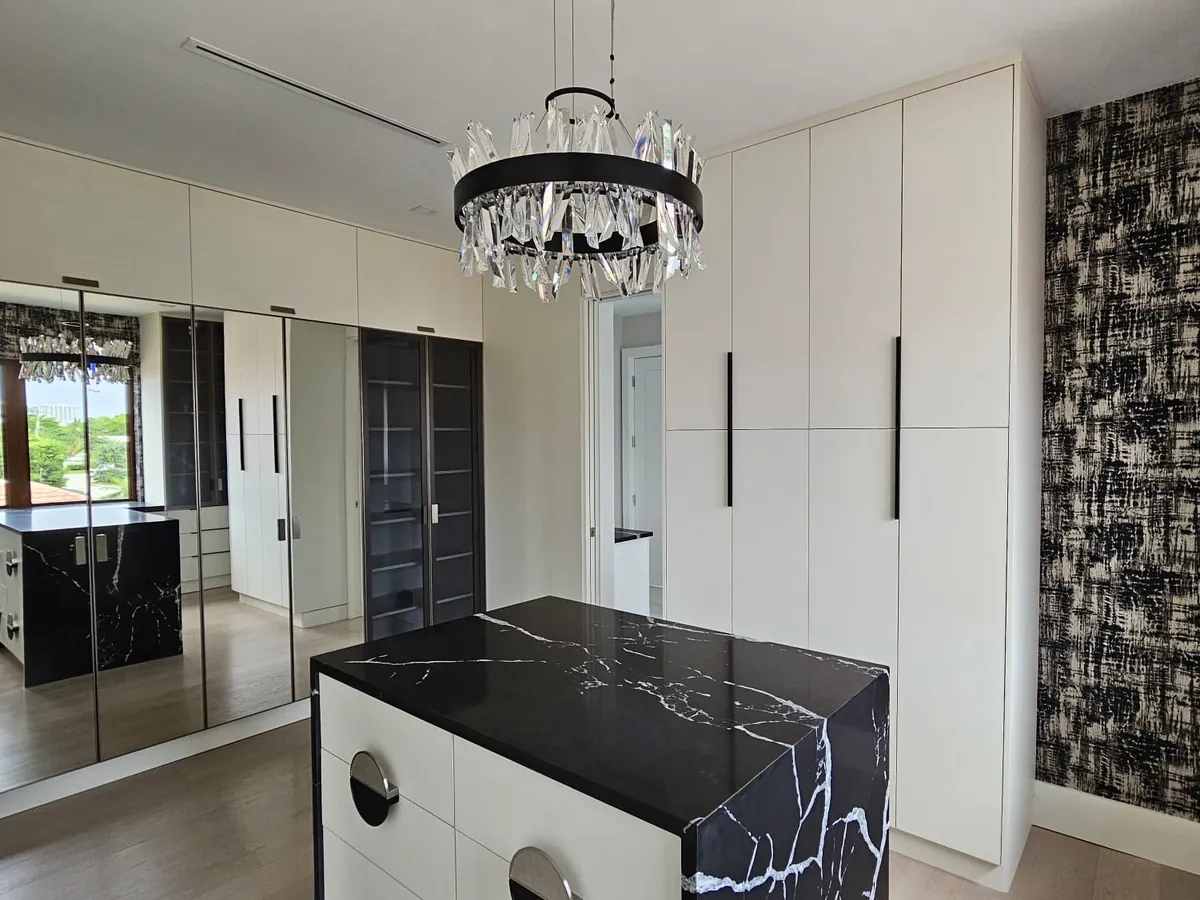
Custom closets cover a huge range, from a reach-in with double hanging and a few shelves to a walk-in dressing room with a stone-topped island, lit glass wardrobes and a wall of drawers. That's why a single "average price" isn't much help.
Is a custom closet the same as a closet system?
Not quite. Many closet companies sell closet systems: standard components, often melamine panels in set widths with wall-hung or floor-standing supports, configured for your space. That can work well, and it's often what people picture when they hear "custom closet."
A built custom closet is designed and built like cabinetry. The boxes, drawers, doors and panels are drawn for your room and built to its measurements, so they can go to the ceiling, wrap a window or a column, and match the finishes in the rest of the house. At Delta Woodworks we build closets the way we build kitchens: measured by us, drawn to fit and built in the USA in our Fort Lauderdale shop, with Blum hardware on every door and drawer.
What are the biggest cost factors for a custom closet?
1. Size and how much wall you use
The amount of wall and the height you build to set the starting point. Going to the ceiling adds cabinetry but also adds real storage for luggage and out-of-season clothes.
2. The mix of hanging, shelves and drawers
Hanging sections and open shelves are the simplest parts of a closet. Drawers cost more, because each one has a box, a front and a pair of runners, and drawer banks are often the biggest single cost driver. They're also the part people use most, so plan them carefully rather than cutting them first. Our closet planning guide explains how to size the zones.
3. Doors and glass
An open closet costs less than one with doors. Solid doors add cost; glass-front doors with frames add more, especially when the glass is lit from inside. In a primary walk-in, glass wardrobes are often the feature people remember, so many owners put glass on one or two walls and leave the rest open.
4. Islands
An island with drawers and a top for folding or laying out clothes is a small piece of furniture in itself. Size, drawer count and the top material (wood, laminate or stone) drive its cost. A stone top is usually supplied by a fabricator and templated after install.
5. Lighting
LED strips in shelves, along rods and inside glass cabinets are planned before the closet is built, with an electrician bringing power to the right spots. Lighting adds cost, and it's also what makes dark clothes easy to tell apart.
6. Materials and finishes
Box material, finish and color all affect price. Closets carry real weight in shelves of jeans and drawers of folded clothes, so we build closet boxes and shelves from Columbia Forest plywood. Wood-grain, painted and high-gloss finishes each take different amounts of work, and special pieces such as leather-lined drawers or mirrored doors add more.
7. Accessories
Jewelry dividers, pull-out hampers, valet rods, pull-down rods, shoe shelving, belt and tie organizers, a safe cabinet, a built-in vanity or seating. Each one is a small cost; together they add up. Pick the ones that solve a real daily annoyance.
8. Site and access
Removing old wire shelving, patching walls, adding outlets and working inside a condo tower with limited hours and service-elevator reservations all affect the install. See our condo guide; the same building rules apply to closets.
How do reach-in and walk-in closets compare?
A reach-in is shallow, so cost goes into using every inch: double hanging, a drawer stack and shelves to the ceiling. It's usually the smaller project.
A walk-in is a room. Cost grows with the number of walls you fit out, the drawers, the doors and glass, the island and the lighting. A walk-in also needs room to move, so the layout is planned around circulation before storage.
How do doors, finishes and the rest of the house fit together?
In a primary suite, the closet often opens straight off the bedroom or the bath, so its doors and finishes are part of how those rooms look. Some owners match the closet to the bathroom vanity or to a bedroom wall unit, so the suite reads as one design. Others make the closet a contrast: dark wood or lit glass behind a plain door. Either way, choose the finish with samples in the closet's own light, since closets are often lit very differently from the rest of the house.
Mirrored doors are worth considering in a smaller walk-in or a bedroom reach-in, because they double as a full-length mirror and make the space feel bigger. Sliding doors suit tight spaces where swing doors would hit the bed or another door.
Where is it worth spending on a closet?
- Drawers in the right places, with good runners. Soft-close Blum runners make them smooth for years; see our Blum guide.
- Shelves that don't sag under folded clothes.
- Lighting where you actually choose clothes.
- Ventilation. A closed closet on an exterior wall can get musty in South Florida. See our humidity guide.
Where can you save on a custom closet?
- Open shelving or open hanging on secondary walls, with doors only where you want them.
- Glass on the feature wall only.
- A smaller island, or a dresser-height drawer bank against a wall instead.
- Fewer specialty accessories, chosen for what you really own.
Is a custom closet worth it?
For a closet you use every day, usually yes. A closet built around your wardrobe saves time every morning, keeps clothes in better condition and makes a room look finished. If the rest of the house has custom kitchen cabinets or built-ins, a closet built by the same shop can match their finishes and quality.
How do you get an accurate closet price?
- Take an inventory: long hanging, short hanging, folded, drawers, shoes, bags and accessories.
- Measure the walls, ceiling height, windows, doors and outlets roughly, and take photos.
- Decide on doors, glass, lighting and an island.
- Visit the showroom to see finishes and hardware, then let us measure and draw it.
Our showroom is at 2416 S Andrews Ave, Fort Lauderdale, FL 33316. See our custom closets page or call 954-939-8579. We build closets across Broward, Miami-Dade and Palm Beach County, north to Tequesta.